
Riftbound Spiritforged FAQ
Hi all! We’ve heard your questions about Spiritforged, and we’d like to address some of them. We also need to issue some clarifications of intent where the current version of the Core Rules is ambiguous or misleading. These clarifications will be incorporated into the next iteration of the Core Rules.
As part of these revised and clarified rulings, we have also updated some card wordings (this is called errata). We previously announced plans to issue errata via a database called Watcher. These plans are still in the works, and we’ll update you when we can!
This document has three sections:
Outstanding Issues from the Origins FAQ, including some errata to Origins and Spiritforged cards
Functional Errata for a small number of other cards in Spiritforged
Rules Clarifications about cards whose intended function may not be obvious in the current rules
The errata are also available as a separate document.
This FAQ includes far fewer errata and rules revisions than the Origins FAQ, but it still includes more than we’d like. The reason for this lies in part with the long lead times for physical games. Spiritforged card text was already finalized when many of the rules and templating decisions in the Origins FAQ and errata were made, so some of this is just catching up. We expect the need for “day 0” errata to (continue to) decrease as our rules stabilize and our production catches up to the real world.
We’re well aware that the formatting and cadence of our rules guidance have room for improvement, and we’re committed to making those improvements in the coming months. For now, though, we wanted to get clarifications and errata into players’ hands in time for Chinese tournaments with Spiritforged cards. These clarifications take effect immediately.
One other note about errata, as always: Errata may impact the effective power level of cards, but we have no plans to issue errata strictly for power level reasons—only to make cards work within the rules and as intended.
Throughout this document, we use some specific shorthand to represent symbols in card text. Here’s a short guide:
- [E] means “exhaust”
- [M] means “Might”
- [A] means “one power of any domain”
- [C] means “one power of this card’s domain”
- [C] in Accelerate costs takes on the domain of the unit, or turns into [A] if the unit has no domain or multiple domains.
- [C] in other cases is treated as the corresponding power symbol in all respects, matching how the cards are actually printed—it’s just a design shorthand!
Origins FAQ Outstanding Issues and Errata
Some categories of errata that we made in the Origins FAQ also apply to Spiritforged cards, but weren’t made in time to be included in their printed versions. We’ve also got a few loose ends in Origins to tie up.
Falling Star, Icathian Rain, and Deflect
The Origins FAQ impacted these two Origins cards in ways that ultimately went beyond our original intentions for them, and we haven’t been happy with the result. We’ll turn over the mic to Riftbound Game Director Dave Guskin to talk about two prominent Origins cards that are receiving errata:
Hey all, Dave here! As we developed more and more designs that needed to perform effects after an initial effect resolved, we added in a new type of trigger called a reflexive trigger. These triggers are the way that a spell or ability can use information from a first effect, and still allow other players to respond now knowing that information before the second effect resolves.
We used a straightforward template (or formal wording) to identify reflexive triggers, the "then do this:" template. And because Icathian Rain and Falling Star were already using a similar template, I ended up pushing forward with changing those cards to reflexive triggers even though they didn't have a first effect -> information -> second effect kind of flow.
This was a mistake, and we shouldn't have done this—it has a lot of weird unintuitive consequences for gameplay that make these two cards play different than one might expect, and also worse.
For those reasons, we're changing these two cards to work the way other spells work and the way we think players want them to work—that is, you pick all the targets up front, the other player can react before any of it resolves, and then each of the units affected take the damage on resolution. You can still choose the same unit or different units for each choice.
Falling Star (revised text) | 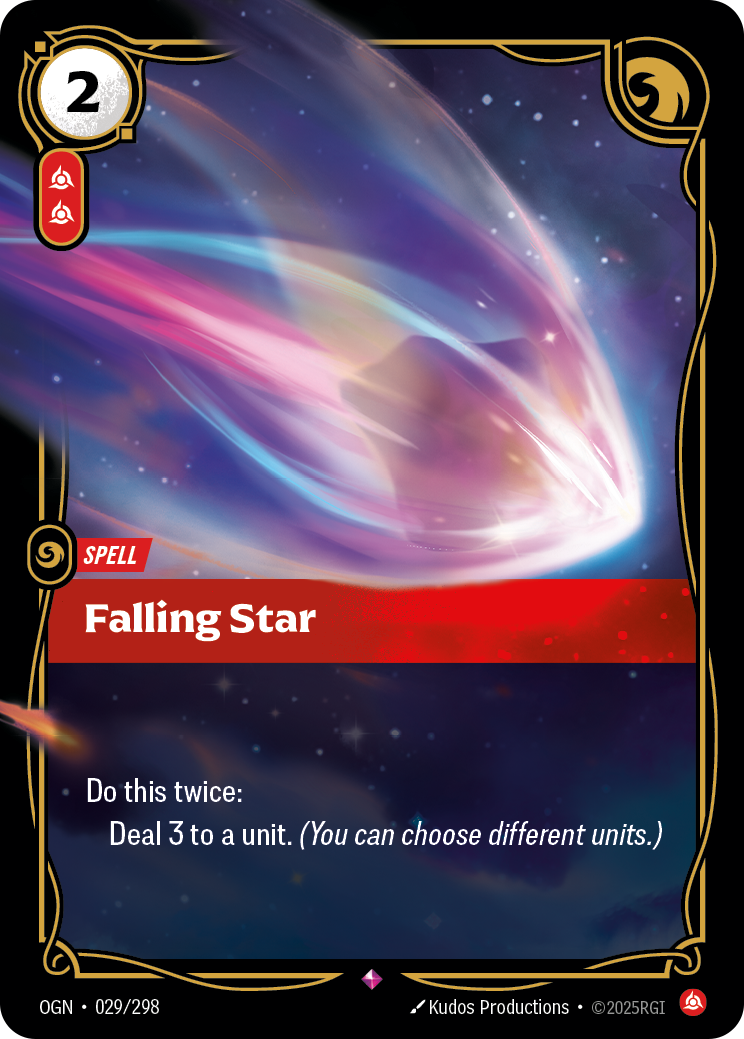 |
Deal 3 to a unit. Deal 3 to a unit. (You can choose different units.) |
Icathian Rain (revised text) | 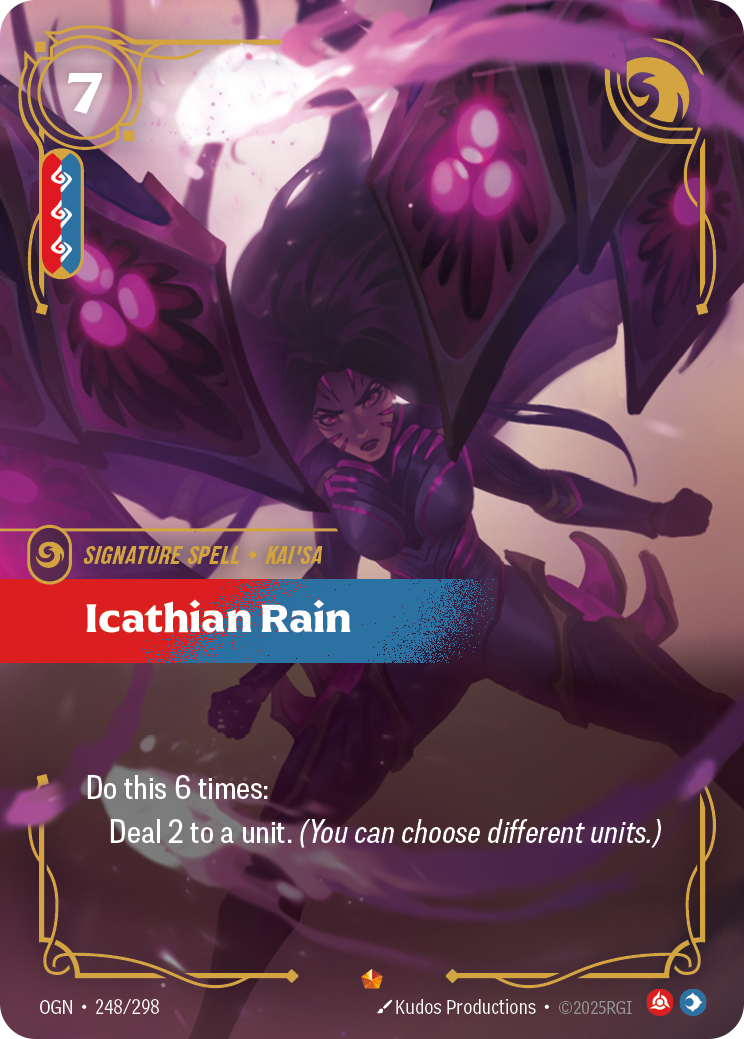 |
Deal 2 to a unit. Deal 2 to a unit. Deal 2 to a unit. Deal 2 to a unit. Deal 2 to a unit. Deal 2 to a unit. (You can choose different units.) |
In addition to these card changes, we have a small rules change to make. We’ve realized that our design team and rules team weren’t in agreement about how Deflect was supposed to work. In the rules, a target’s Deflect cost was paid once for each spell or ability. In the design team’s playtesting, it was paid once for each time that target was chosen. That misalignment didn’t actually matter—Icathian Rain and Falling Star had reflexive triggers, so they worked as intended, and there were no other cards (that we could find) that can choose the same unit multiple times. Now that difference does matter, both because of the above errata and the existence of the Repeat ability, and we want the cards to play as the design team intended. To that end, we’re taking the unusual step of issuing errata for the rules themselves:
Rule 735.1.c (revised text) |
It is functionally short for "Spells and abilities an opponent controls that choose me cost an amount of Power equal to [Deflect Value] more to play as an additional cost for each time they choose me." |
Cards that Tell You to Play Other Cards from Your Deck
Q: Origins cards that instruct players to play cards from their deck, like Promising Future and Blind Fury, received errata to banish those cards before playing them. Will Spiritforged cards with similar abilities receive similar errata?
Yes! This is mostly a bookkeeping thing—banishing the card ensures that the game has a place to put the card until it’s actually played, and a place to send the card back to if it can’t be played for whatever reason. 99% of the time, these cards work the same with or without this errata, but we need to cover those weird corner cases. This impacts 3 Spiritforged cards, plus 1 Origins card that got past us last time.
Rek’Sai, Swarm Queen (revised text) | 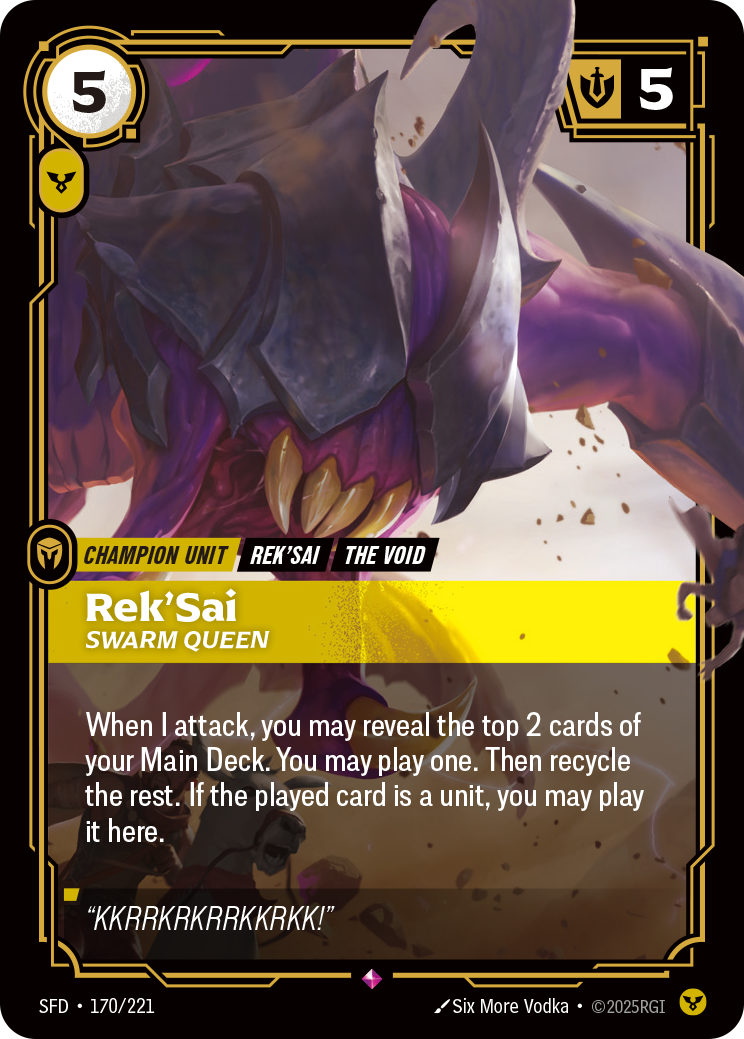 |
When I attack, you may reveal the top 2 cards of your Main Deck. You may banish one, then play it. If it is a unit, you may play it here. Recycle the rest. |
Void Burrower (revised text) | 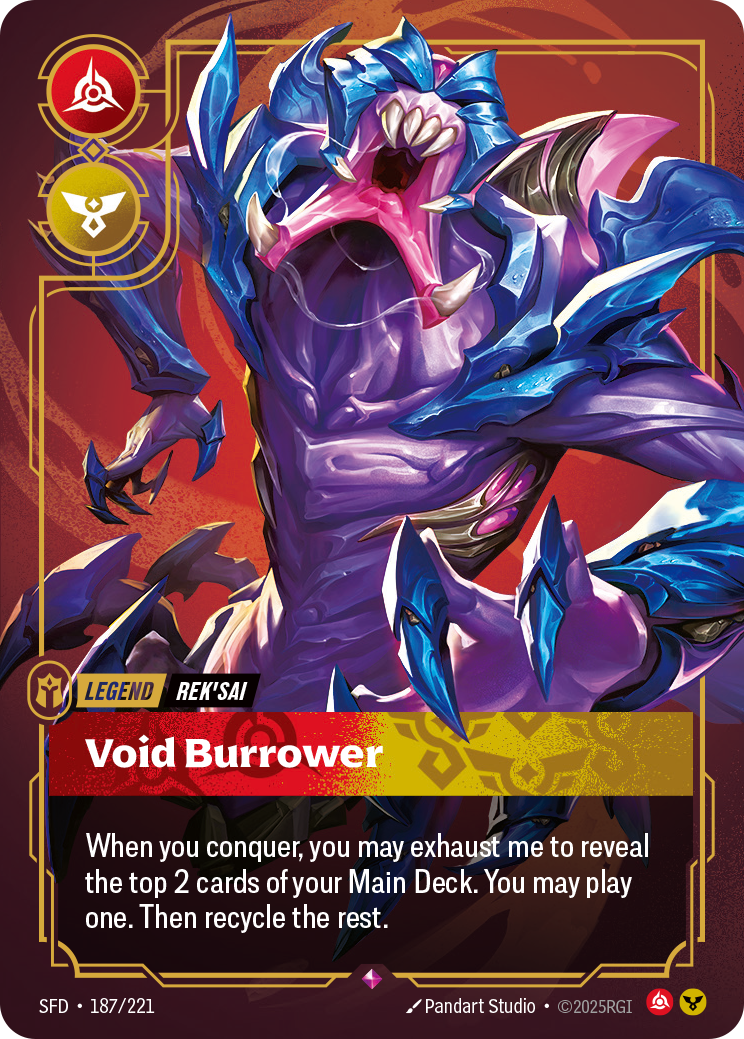 |
When you conquer, you may exhaust me to reveal the top 2 cards of your Main Deck. You may banish one, then play it. Recycle the rest. |
Void Rush (revised text) | 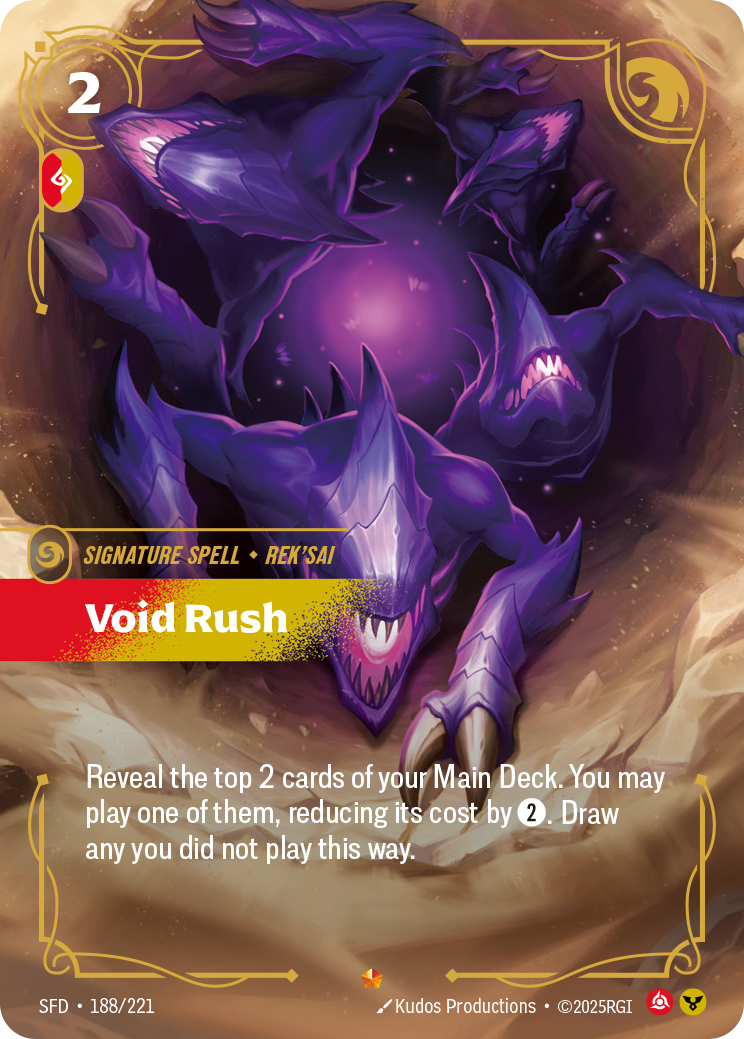 |
Reveal the top 2 cards of your Main Deck. You may banish one, then play it, reducing its cost by [2]. Draw any you didn't banish. |
Reinforce (revised text) | 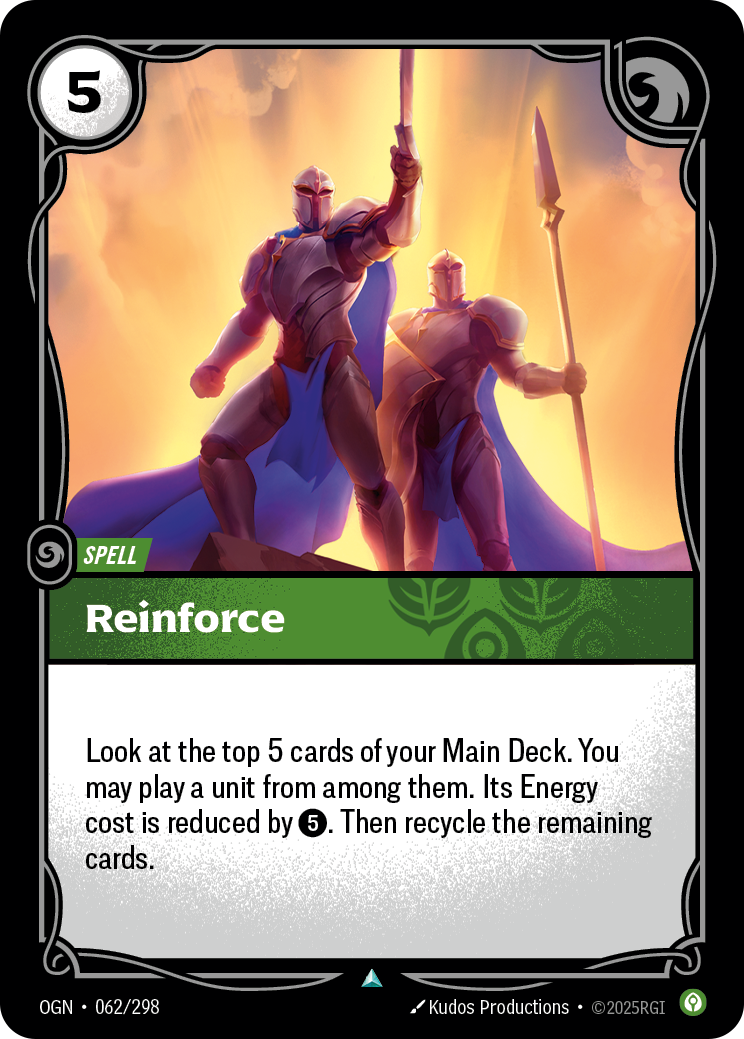 |
Look at the top 5 cards of your Main Deck. You may banish a unit from among them, then play it, reducing its cost by [5]. Recycle the remaining cards. |
Reflexive Triggers on Spiritforged Cards
Q: Should the reflexive trigger system introduced in the Origins FAQ apply to any cards in Spiritforged?
Yes! This is another one where if you don’t know the finer points of the rules, you’re probably already playing these cards correctly, but the machinery of the rules requires a slightly different wording than we thought. Reflexive triggers, identified by “do this:” language, create new chain items to handle things that need to offer players a chance to react, or just need to happen later than the rest of a spell or ability. This impacts 2 cards in Spiritforged, both of which let you play something and then try to do something to that thing.
Arise! (revised text) | 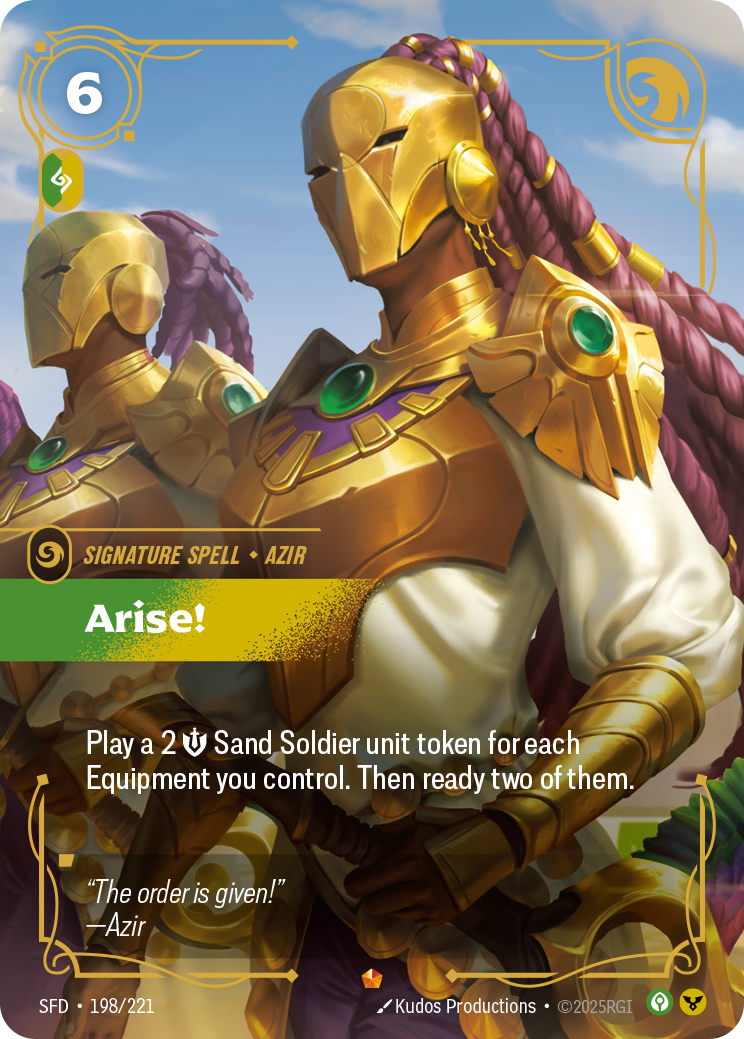 |
Play a 2 [M] Sand Soldier unit token for each Equipment you control. Then do this: Ready up to two of them. |
Rell, Magnetic (revised text) | 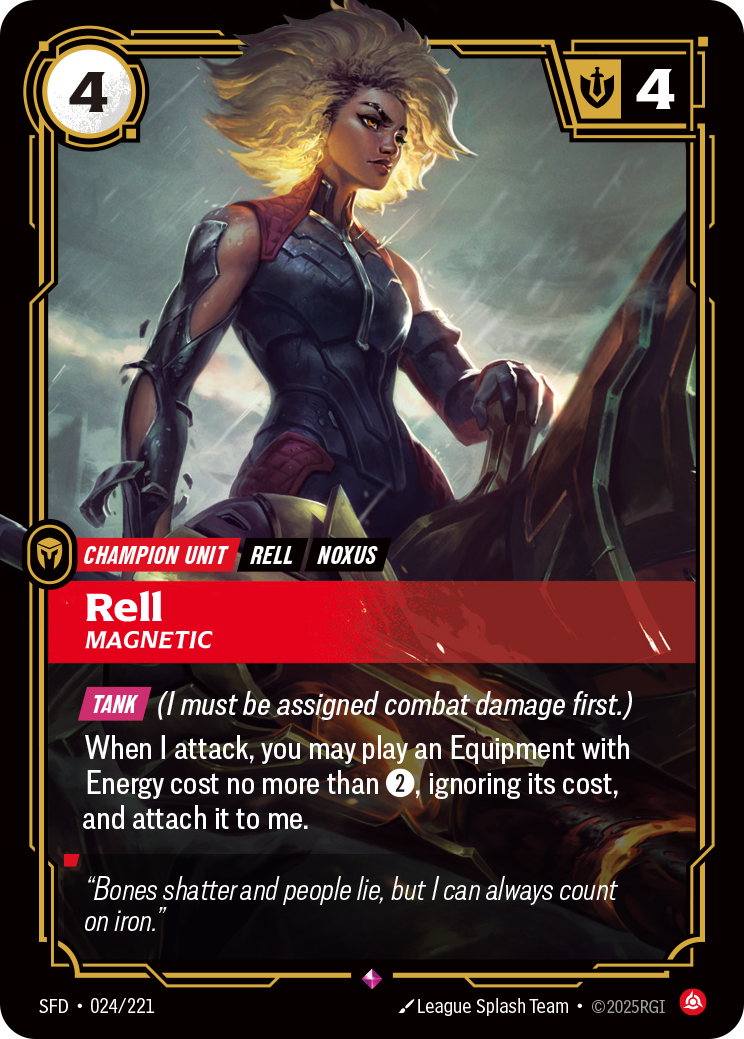 |
Tank (I must be assigned combat damage first.) When I attack, you may play an Equipment with Energy cost no more than [2], ignoring its cost. If you do, then do this: Attach it to me. |
Spiritforged Functional Errata
A handful of cards in Spiritforged were printed with text that either doesn’t quite work, or technically works but goes against design intent and (we think) common sense. We’re issuing errata to maintain these cards’ intended function.
Blood Rush
Q: Should Blood Rush say “this turn” on it?
It should! Like Convergent Mutation in Origins, the phrase “this turn” was accidentally omitted.
Blood Rush (revised text) | 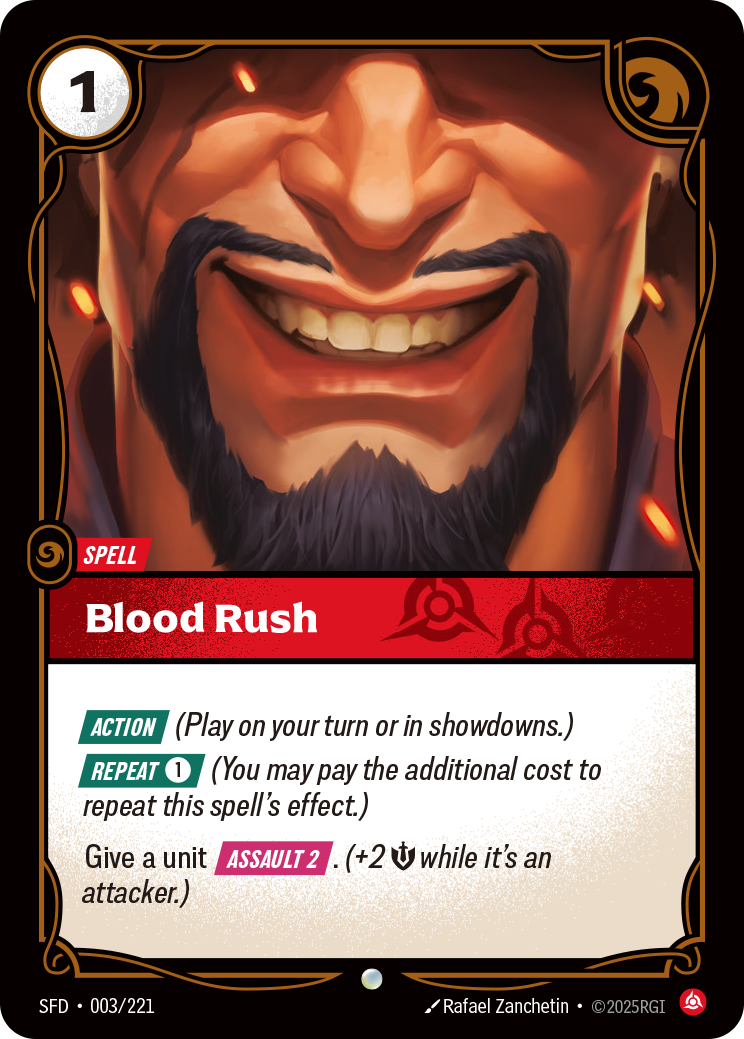 |
[Action] (Play on your turn or in showdowns.) [Repeat][1] (You may pay the additional cost to repeat this spell's effect.) Give a unit [Assault 2] this turn. (+2 [M] while it's an attacker.) |
Deathgrip
Q: Is the first friendly unit on Deathgrip a cost or a target? When do I kill it, and what happens if I don’t?
Deathgrip uses a nonstandard wording that we normally avoid, precisely because of these ambiguities. We’re issuing errata to bring it more in line with how other cards and abilities work. This errata establishes that 1) the friendly unit is a target, not a cost; 2) it is chosen along with the other friendly unit and killed as the spell resolves; 3) if you don’t actually kill it for any reason, either because it’s no longer a legal target or because you replaced its death with an effect like Zhonya’s Hourglass, you do not give the second friendly unit any Might. (You do still draw 1; we’ve introduced a paragraph break to make that clear.)
Deathgrip (revised text) | 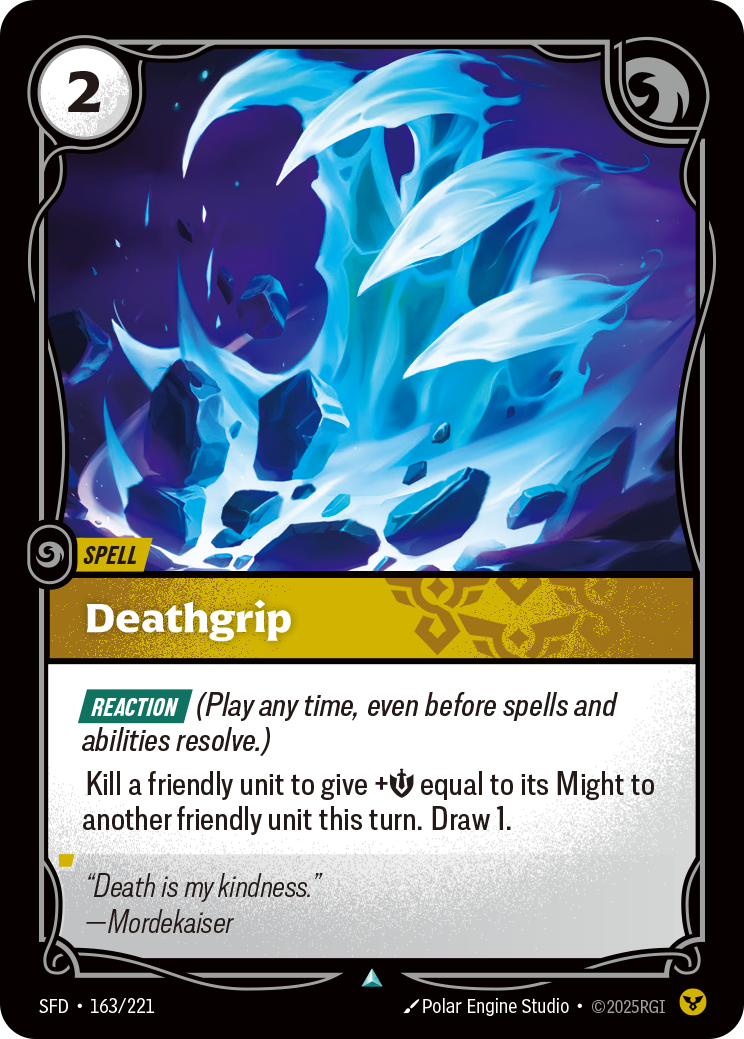 |
[Reaction] (Play any time, even before spells and abilities resolve.) Kill a friendly unit. If you do, give +[M] equal to its Might to another friendly unit this turn. Draw 1. |
Edge of Night
Q: Does Edge of Night’s auto-attach ability work?
Because unattended gear at battlefields are recalled, Edge of Night does a strange little dance on its way to becoming attached, returning to your base while its ability is on the chain. And because of that dance, it’s no longer “here” when the attachment is supposed to happen. We need to change its wording so it can still find the unit you chose.
But we don’t want any confusion here—the card works exactly the same as it did before. The Hidden rules still require that you choose a unit at the battlefield where you played it from face down. For that reason, we’ve included reminder text in the errata.
Edge of Night (revised text) | 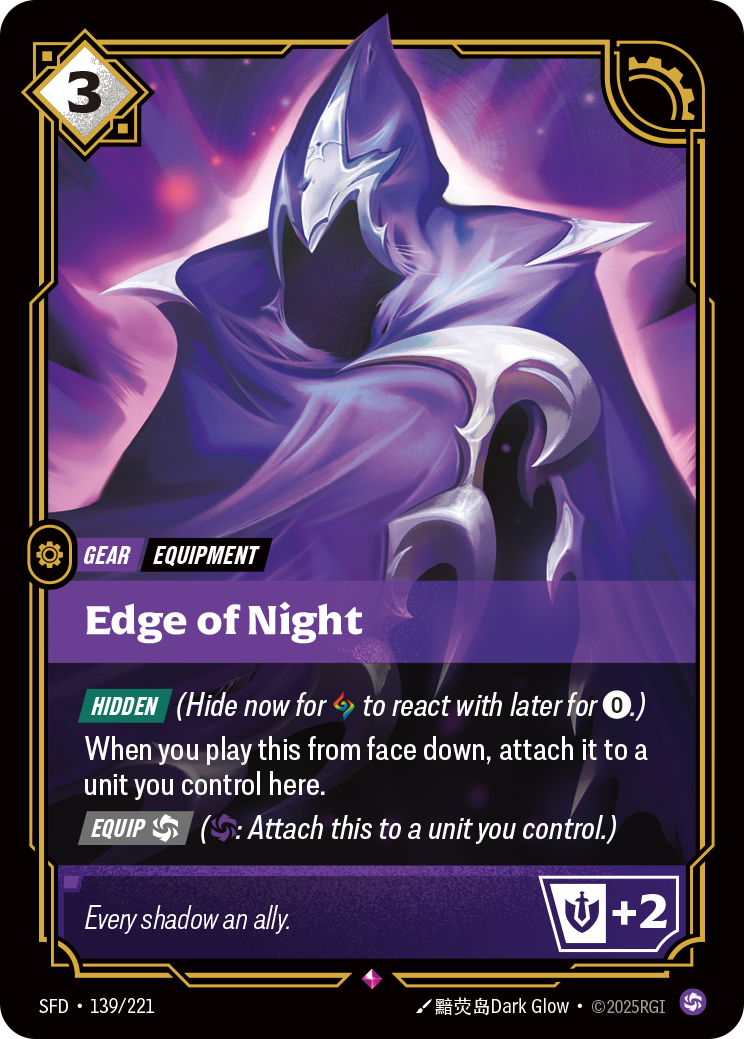 |
[Hidden] (Hide now for [A] to react with later for [0].) When you play this from face down, attach it to a unit you control (here). [Equip] [C] ([C]: Attach this to a unit you control.) |
Janna, Savior
Q: Can Janna’s play effect be used to heal my units without an enemy unit present?
Triggered abilities in Riftbound can’t be placed on the chain unless all required targets can be chosen. They can resolve and perform part of their text without all targets still being available, but all targets must be available to put them on the chain to begin with. This is weird, and we generally try not to force players to know it. We think 99% of players probably expect that Janna can heal their units without enemies present, so we’re meeting that expectation with a simple “up to,” similar to some “up to” errata for triggered abilities in Origins.
Janna, Savior (revised text) | 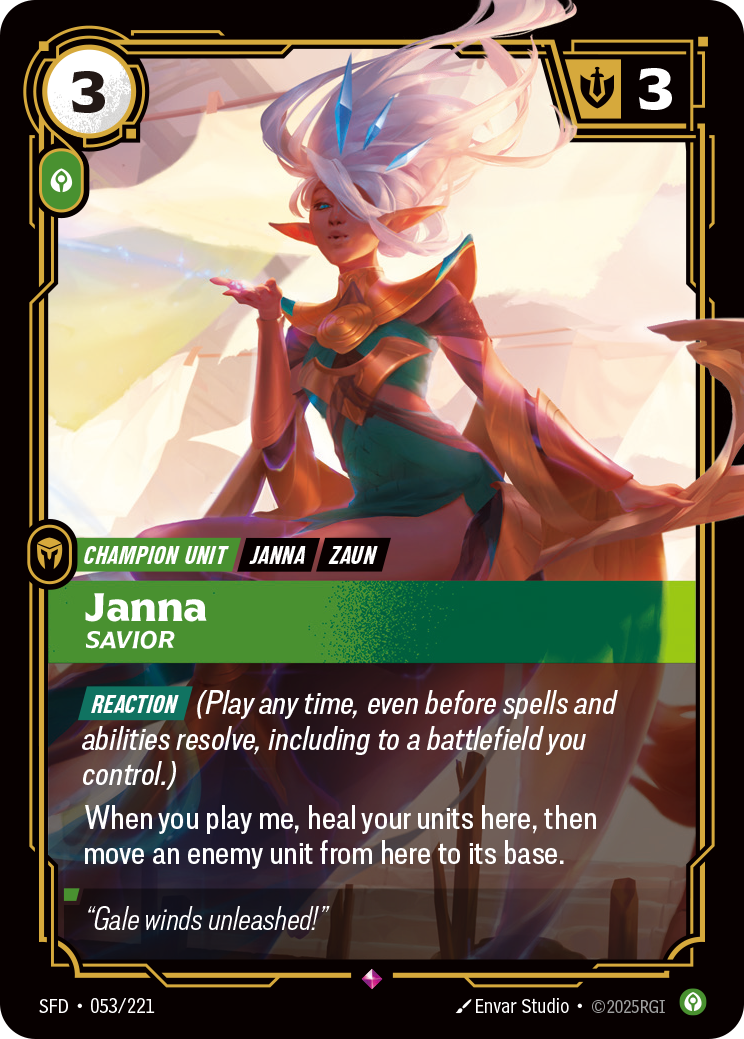 |
[Reaction] (Play any time, even before spells and abilities resolve, including to a battlefield you control.) When you play me, heal your units here, then move up to one enemy unit from here to its base. |
Jax, Unmatched
Q: How does Jax, Unmatched work?
Jax, Unmatched grants Quick-Draw to Equipment in your hand, which works as far as letting you play them as Reactions… but doesn’t work so well when the Equipment hits the board and the other part of Quick-Draw tries to take effect. We’re fixing that.
Jax, Unmatched (revised text) | 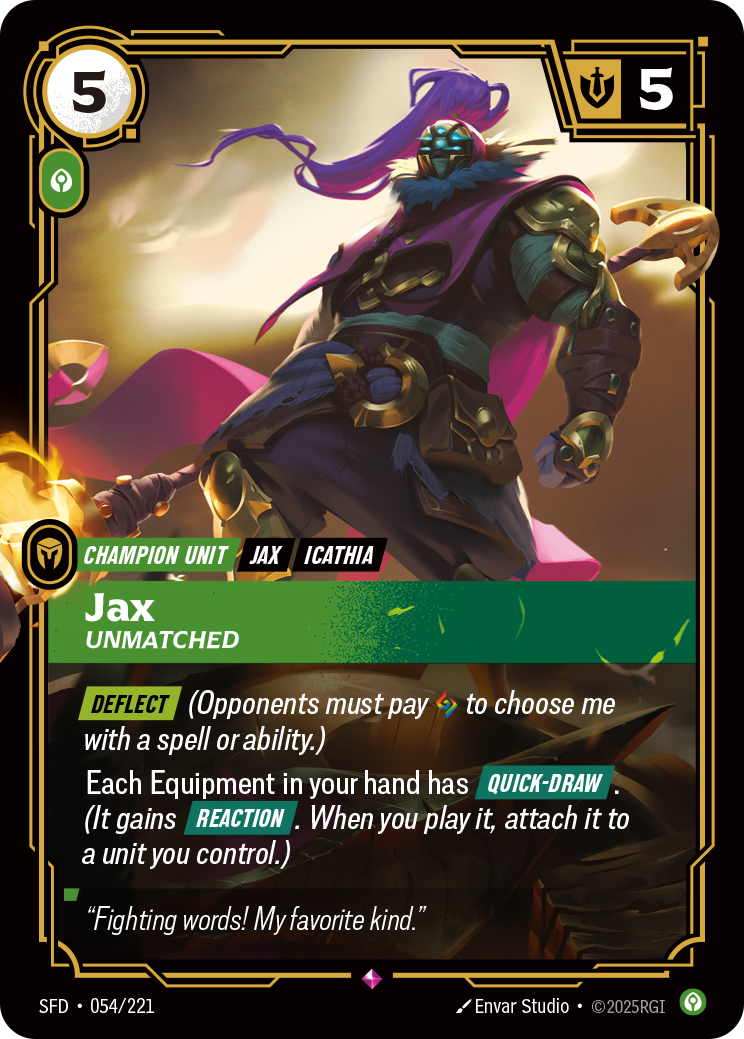 |
[Deflect] (Opponents must pay [A] to choose me with a spell or ability.) Your Equipment everywhere have [Quick-Draw]. (Each gains [Reaction]. When you play it, attach it to a unit you control.) |
Kato the Arm
Q: Can Kato the Arm give himself his own Might and keywords?
“Friendly unit” does properly include Kato himself, but that wasn’t the intent behind this card—Kato can’t throw himself, after all. It was a simple goof that Kato made it out the door without the word “another,” and the gameplay is so divergent from the design intent that we’re changing it to fix this error.
Kato the Arm (revised text) | 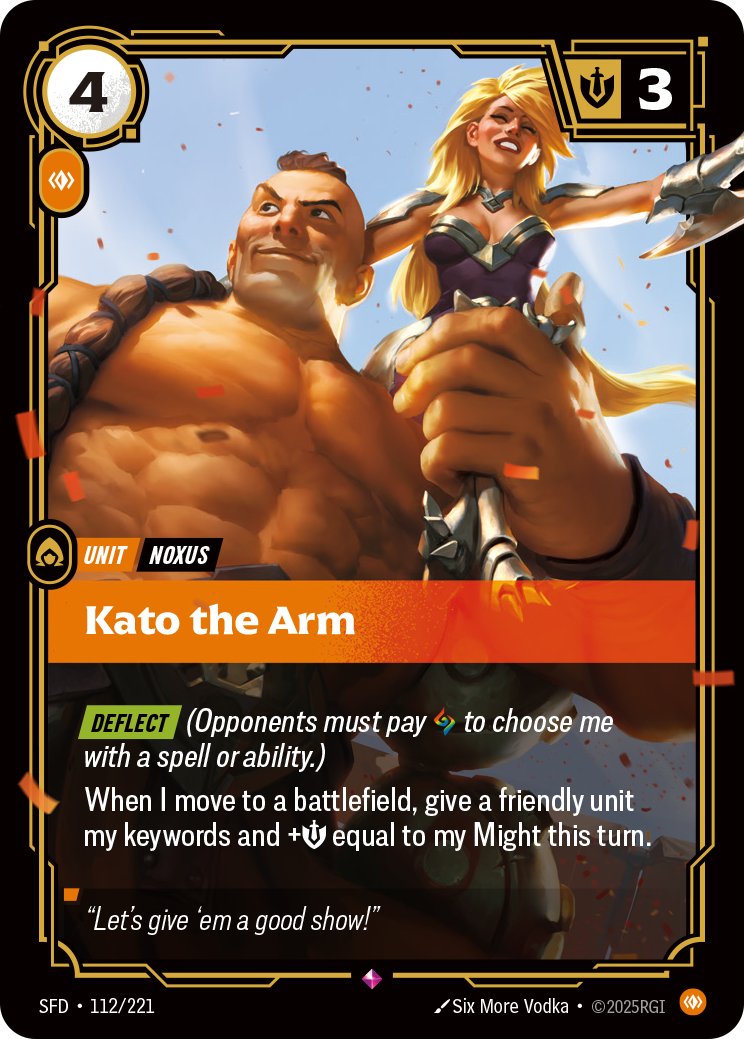 |
[Deflect] (Opponents must pay [A] to choose me with a spell or ability.) When I move to a battlefield, give another friendly unit my keywords and +[M] equal to my Might this turn. |
Q: Does Kato give keywords he’s gained during play? What about Might bonuses from various sources like Equipment?
Yes. Kato gives his current keywords and additional Might equal to his current Might to the unit you choose. Later changes to Kato don’t matter; what the unit gets is locked in as the ability resolves.
Tianna Crownguard
Q: Can I still conquer and hold battlefields while my opponent has Tianna? Do I get conquer and hold triggers? What about drawing a card instead of getting the 8th point from conquering?
Riftbound rules and card text use the word “score” in a couple different ways. You can score battlefields; you can also score points, as on cards like Tryndamere, Barbarian. The difference between these two is usually clear… but Tianna muddles them more than we anticipated. Tianna is solely concerned with points and doesn’t interfere with the process of conquering or holding battlefields. You can still conquer and hold battlefields and get your conquer and hold triggers. You can even draw a card if you conquer a battlefield and can’t score because it’s the final point and you haven’t scored every battlefield yet. It’s not until you reach for your scorepad, app, or tracking die that Tianna says “No.”
The “gain points” meaning of score is underdeveloped in the current rules, so in the future we are likely to revisit the rules and/or card wordings for scoring points without scoring battlefields. For now, we’re issuing errata to make Tianna’s function clearer and leaving the rest unchanged.
Tianna Crownguard (revised text) | 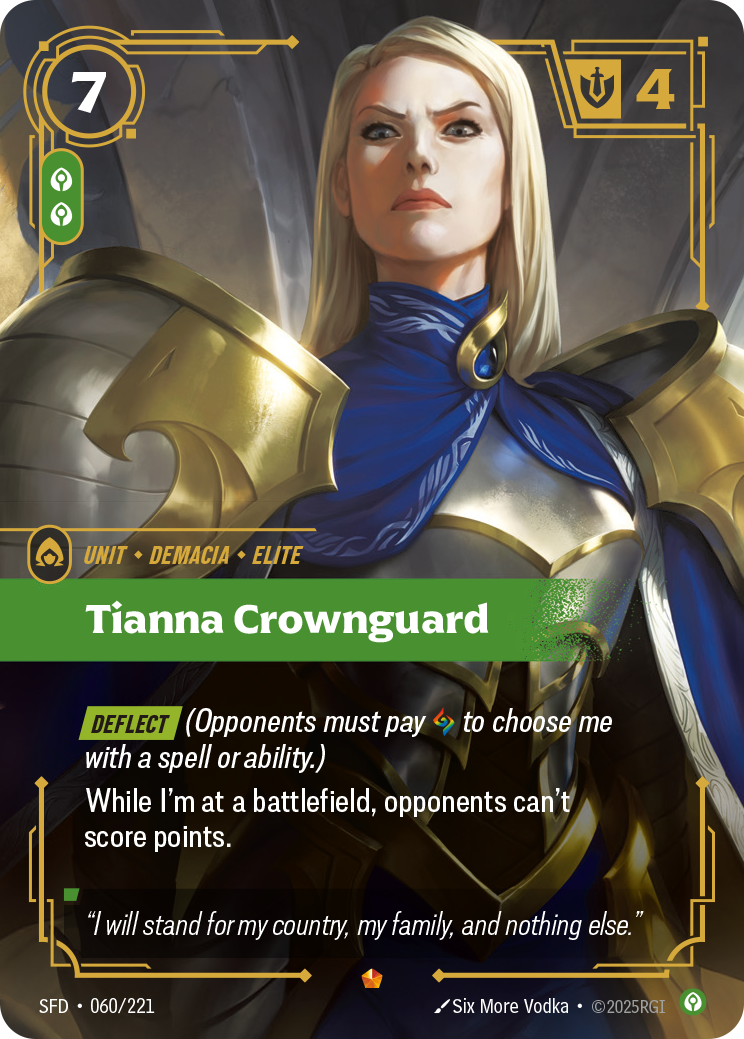 |
[Deflect] (Opponents must pay [A] to choose me with a spell or ability.) While I'm at a battlefield, opponents can't gain points. |
Q: Does Forgotten Monument work the same as Tianna? Will it receive similar errata?
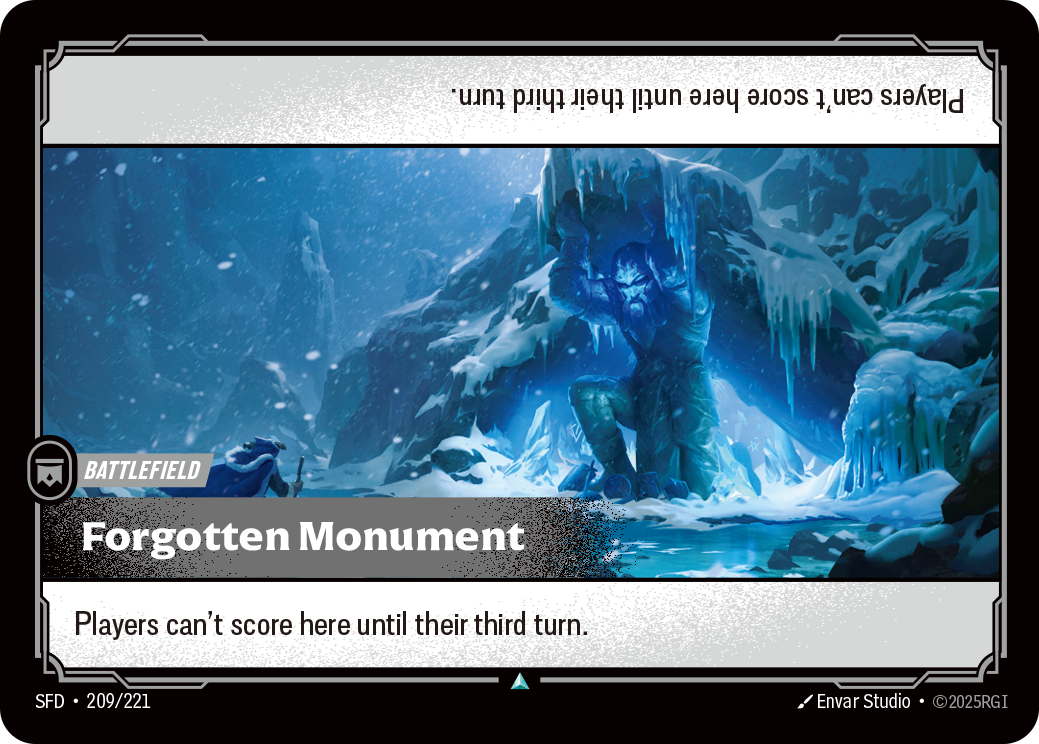
Forgotten Monument works differently from Tianna, and we agree that’s confusing. That’s part of why we decided to issue errata for Tianna (and not for Forgotten Monument).
Forgotten Monument completely prevents the process of scoring there. That means no conquer triggers, no hold triggers, and no points from doing those things. “Extra” points such as those from Renata Glasc, Mastermind are unaffected. You can still gain control of the battlefield following a showdown—you just can’t conquer it.
Yone, Blademaster
Q: When and how does Yone trigger? If you conquer a battlefield, is it still open?
Yone’s current text is a little, well, open to interpretation. A strict reading suggests that he can never trigger at all—once you’ve conquered a battlefield, it’s no longer open—but obviously that’s not the intent. We’re tweaking his text to cue off the control status of the battlefield immediately before conquering it. This means that he works as intended, triggering at the end of a noncombat showdown in which he conquers. It also means that he now triggers in “surprise defense” scenarios, caused when units move around during showdowns and you wind up defending a battlefield you don’t control.
Yone, Blademaster (revised text) | 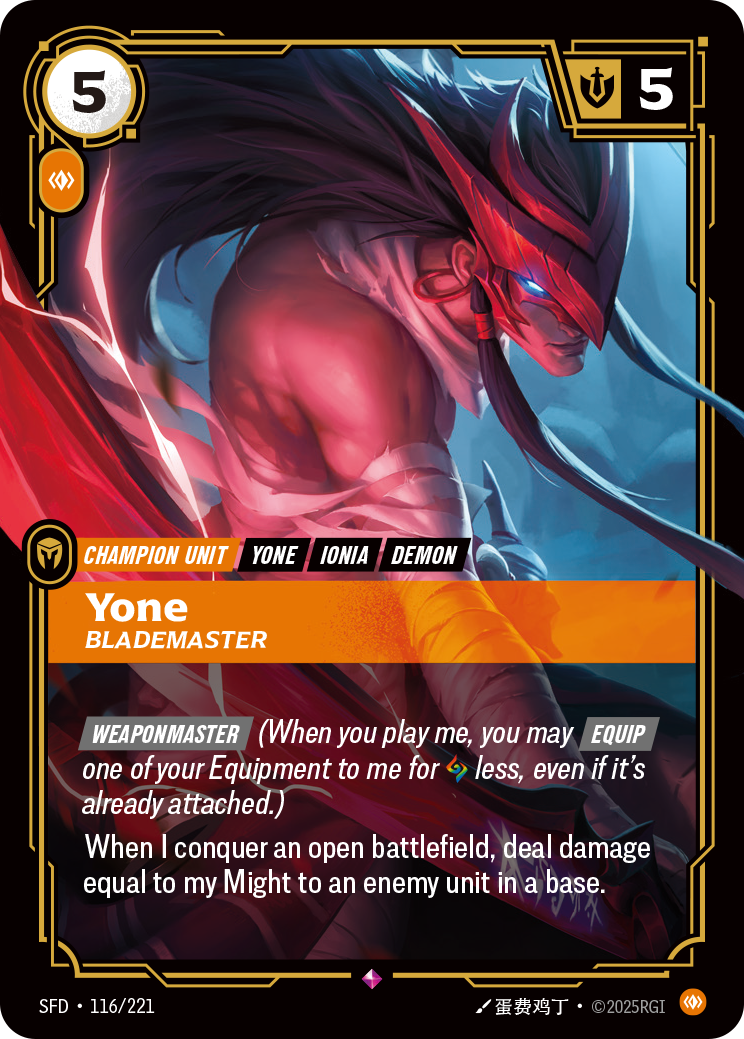 |
[Weaponmaster] (When you play me, you may [Equip] one of your Equipment to me for [A] less, even if it's already attached.) When I conquer a battlefield that was uncontrolled, deal damage equal to my Might to an enemy unit in a base. |
Rules Clarifications
There are a few cards in Spiritforged whose function isn’t entirely clear, not because of anything wrong with their text, but because the rules don’t support them as well as they should. A future rules update will fix these oversights, but in the meantime, we’d like to offer guidance on how these cards should be played.
Draven, Audacious
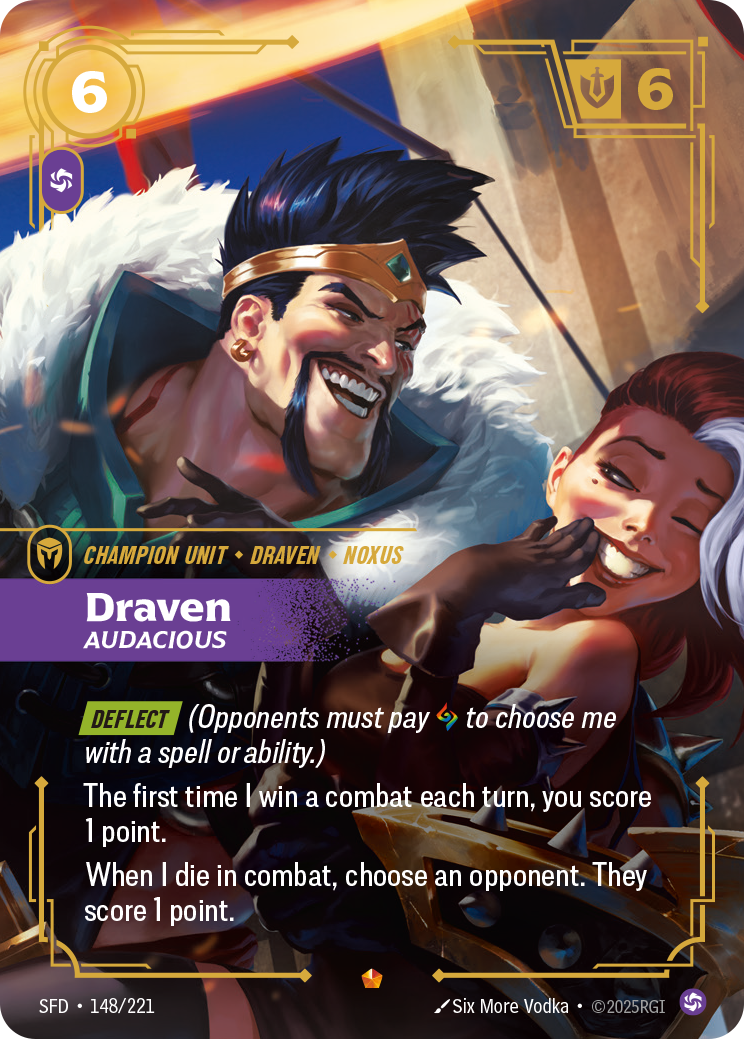
Q: What does it mean to win or lose a combat?
Winning and losing combats is a system that was inadvertently left out of the most recent rules update. Here are the conditions under which you win, lose, or tie a combat.
After combat damage has been dealt:
If neither player has units remaining at the battlefield or both players have units remaining, combat is a tie. If both players do, attackers are recalled.
If only one player has units remaining at the battlefield, that player wins the combat and the other player loses. Draven triggers if he’s among the units that survive.
It doesn’t matter whether combat damage was actually dealt, only that there was a combat showdown and only your units were left after combat damage. If you killed or removed all the opposing units with spells and abilities before Draven had to throw any punches, he still wins. (Think of it as winning by default.)
You can win a combat on either offense or defense.
Q: If I win on the attack and conquer, does this happen before or after I score? Before or after conquer effects?
Draven’s ability will trigger and resolve before you gain your regular point for scoring the battlefield and before any conquer effects are triggered. This means that you can’t win from 6 points by conquering a battlefield with Draven without having scored all other battlefields—you’ll gain your point from Draven, then the game will see that you’re at 7 points and give you a card draw instead of a point for conquering.
Pickpocket
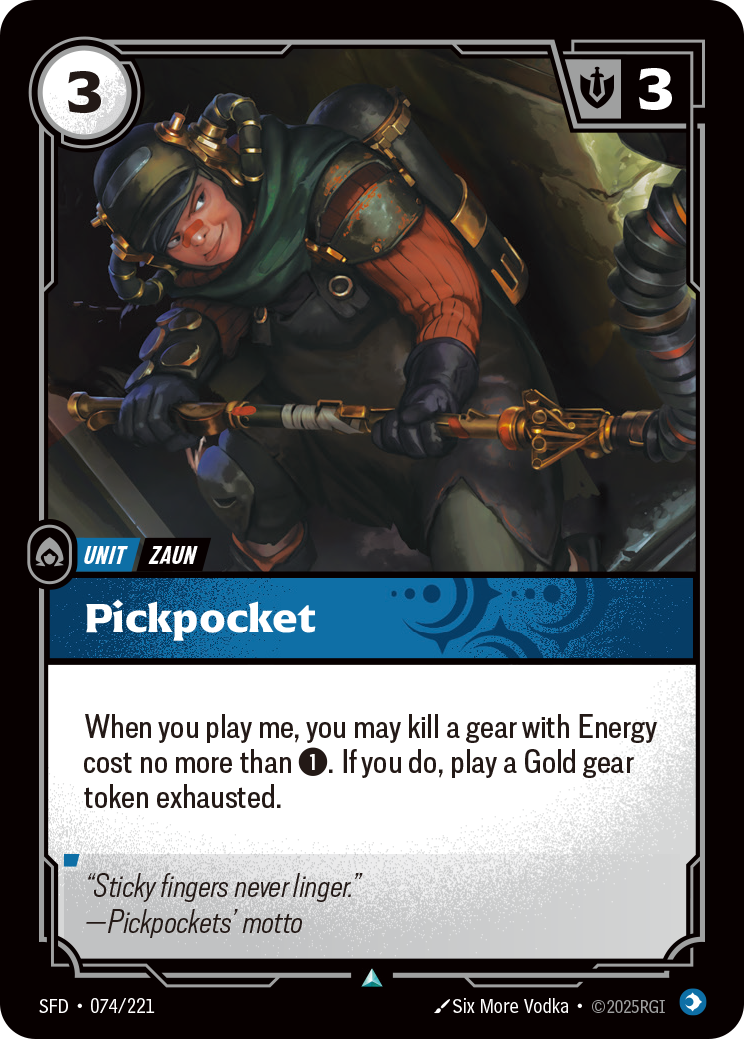
Q: Can Pickpocket kill a Gold token?
Yes, but we see why you’d ask. The rules use a “NULL” system for values that aren’t available, such as the Might of a unit that’s been removed from the board. The unit is gone and the information is missing, so you can’t do any calculations or comparisons with it (not even “is it no more than 1?”).
That system could reasonably be applied to the costs of tokens, but we feel that results in unintuitive situations, like not being able to kill a Gold token with Pickpocket. After all, the token’s not missing; it just doesn’t have a cost because it doesn’t need one. We’ll be updating the rules to clarify that the cost of a token can be treated as 0 for all purposes.
Rumble, Hotheaded
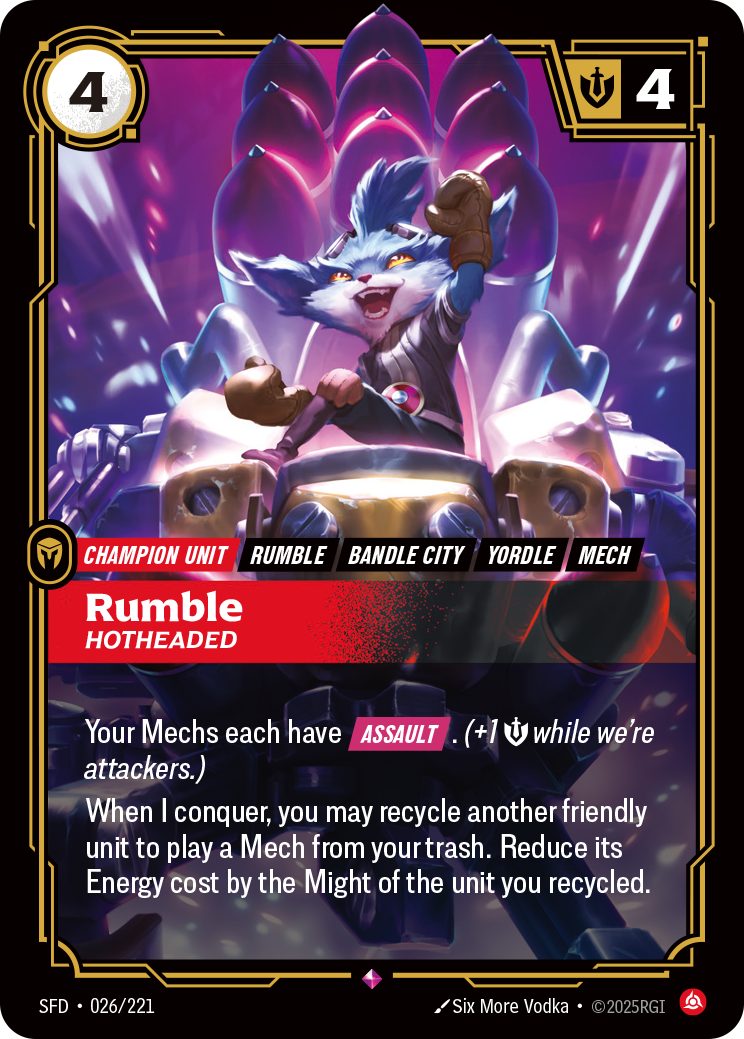
Q: Can Rumble, Hotheaded choose a Mech token to recycle? If he does, where does it go?
Yes, he can. This is a minor gap in the rules. Main Deck cards are recycled to the Main Deck and runes are recycled to the Rune deck, but tokens aren’t actually either of those things. We’ll be clarifying in a future rules updates that tokens “inherit” the recycle destination of their type(s), so a token that’s a unit or gear is recycled to your Main Deck just like any other gear. It then vanishes, as tokens do any time they leave the board, but it still counts as “the unit you recycled” and Rumble can check its Might.
Svellsongur
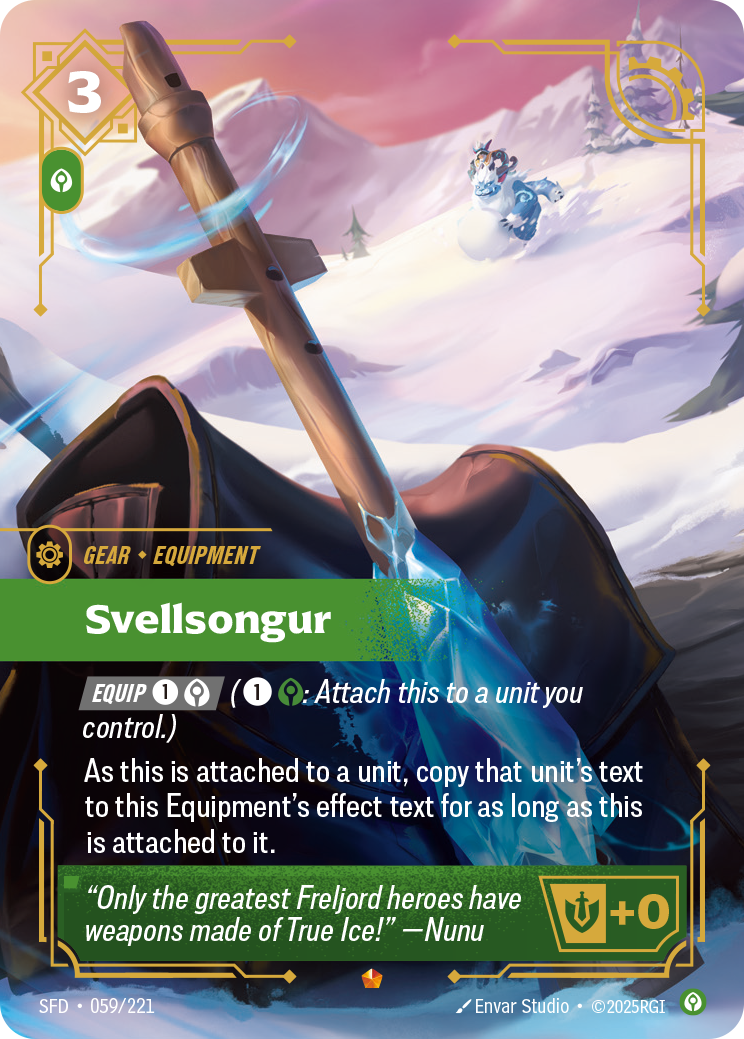
Q: Does Svellsongur copy text that the unit has gained from other sources, such as the Assault granted by Cleave? What about text it’s gained from other Equipment?
No, Svellsongur only copies the text that’s actually printed on the unit. This is an ambiguity in the current rules, which refer to “appending” and “removing” rules text without reference to whether that text is original to the unit or not.
The key word here is actually copy, a system that will be fleshed out in a future rules update. For now, we’ll just tell you that copies of objects or text take on their original traits, without regard to any subsequent alterations.
Svellsongur doesn’t grant the unit additional “copies” of the abilities of other Equipment. So putting 3 Svellsongur on the same unit will give that unit four total instances of its abilities, not eight. (Four should be plenty.)
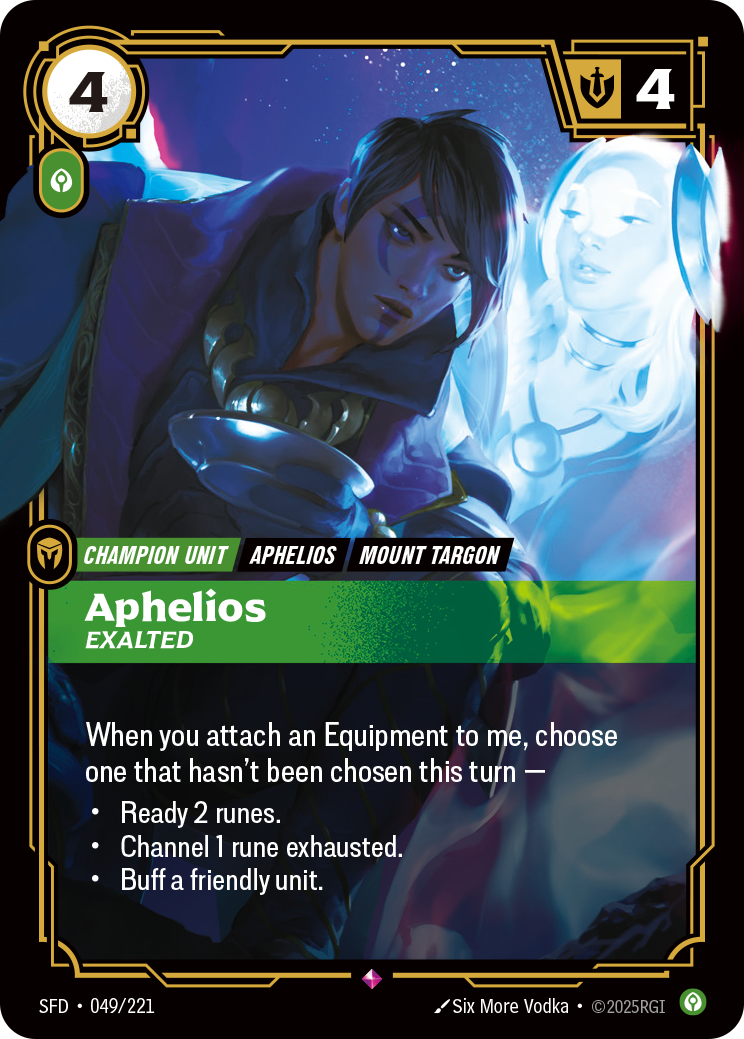
Q: Aphelios, Exalted has an ability that triggers when I attach an Equipment to him and tells me to “choose one that hasn’t been chosen this turn.” If I attach Svellsongur to him, does he have the second copy of his ability in time for both to trigger? And do I have to choose different options?
He does have the second copy of his ability in time, and it will trigger. The “one that hasn’t been chosen this turn” restriction applies separately to each instance of his ability. So you could choose the same option for both, but you’ll have to track which options you’ve used for each copy of his ability.
Cards that Reduce Might
Q: I heard that cards that reduce Might will no longer say “to a minimum of 1” on them. Does that mean Origins cards like Stupefy will receive errata?
No. This is a change to our design philosophy beginning with Spiritforged, but Origins cards will maintain their functionality.
Q: Does this mean that units’ Might can go to 0 or below now?
Units’ Might could always go to 0 or below; it was just really hard to actually make it happen. For example: If a Recruit was at Trifarian War Camp, it would have 2 Might (its 1 base Might, +1 from War Camp). If it got hit with Stupefy, Stupefy would “snapshot” at -1 Might, reducing the Recruit’s Might to 1. If the Recruit then moved away from Trifarian War Camp, it would lose the +1 Might bonus and end up at 0 Might. It’s much easier to make it happen with Spiritforged cards, though, so it’s worth reviewing the rules for units with 0 or less Might.
Q: Does a unit with 0 or less Might automatically die?
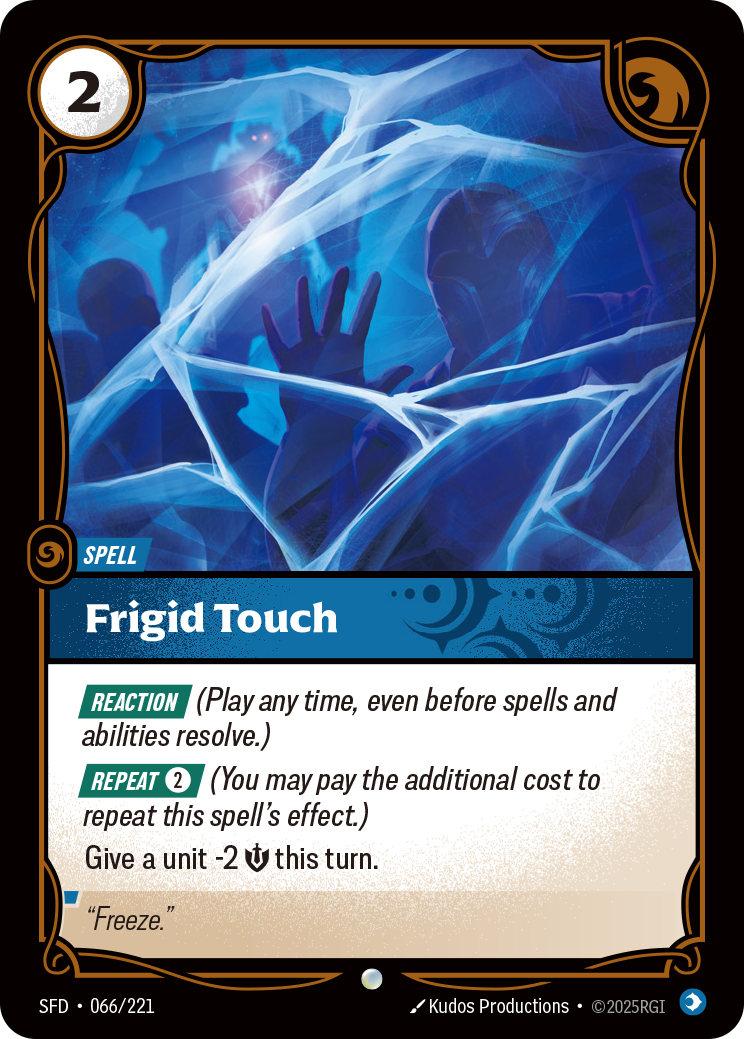
No, units can stick around on the board with 0 (or less!) Might. They will die if they take any damage, but “0” is not a valid amount of damage, so it takes 1 damage to kill a unit with 0 or less Might. We realize that this is a little weird, but it’s important to us that cards like Frigid Touch can’t be used to actually kill units, only weaken them.
Q: Does a unit with negative Might contribute negative damage to my Might total in combat?
No. Negative Might is treated as 0 Might for the purposes of dealing damage, but as its true value for raising it back above 0. So a unit with -3 Might would contribute 0 damage in combat, would die if it was dealt 1 or more damage, and would require +4 Might to get it back up to 1 Might.
Ezreal, Prodigy
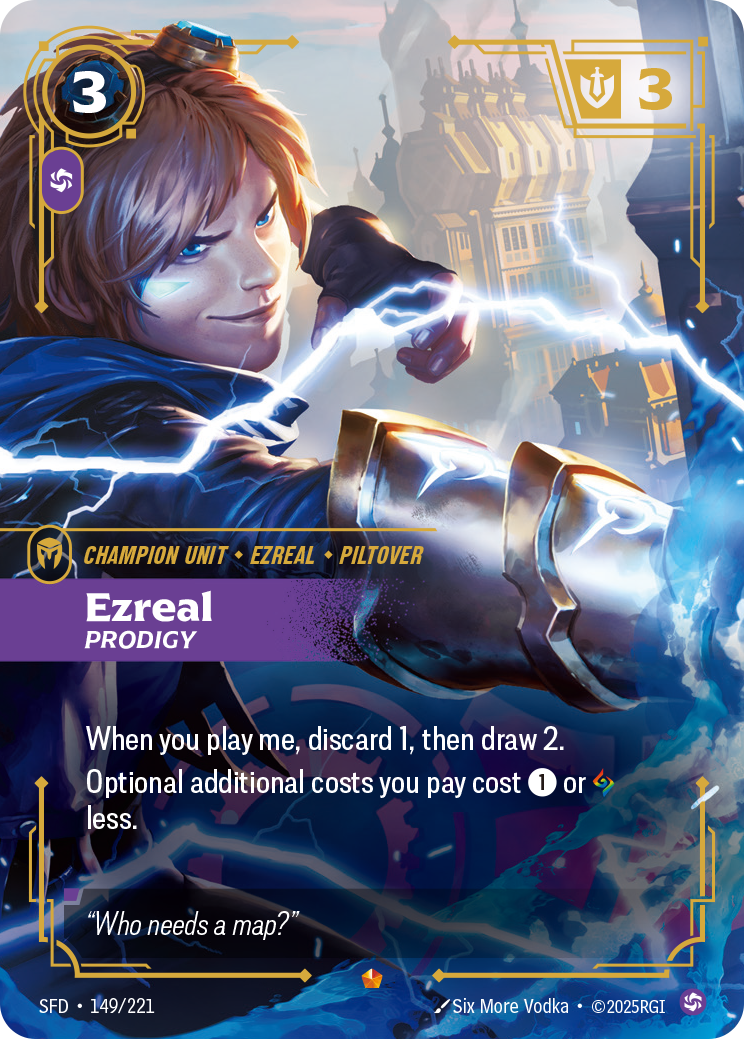
Q: What costs does Ezreal, Prodigy reduce? Does he reduce Repeat costs? Accelerate costs? Equip costs?
Ezreal, Prodigy reduces additional costs that are optional to pay. These will generally use both the words “additional cost” and the word “may.” Repeat and Accelerate are the two main sources of optional additional costs, but Ezreal can also offer a discount for one-off oddballs like Blast Corps Cadet.
Ezreal can’t reduce Equip costs. That’s an activation cost for an ability, so it’s neither optional nor additional. There aren’t currently any optional additional costs that apply to activating abilities.
Q: What about Deflect costs? Aren’t those optional now?
No, Ezreal won’t help with Deflect costs, and Deflect is not optional. Deflect is a mandatory additional cost, meaning you must pay it if you want to finalize a spell or ability that chooses something with Deflect. It’s true that you can choose not to pay Deflect costs for triggered abilities by choosing not to finalize them, but that doesn’t make it an optional cost.
Hostile Takeover
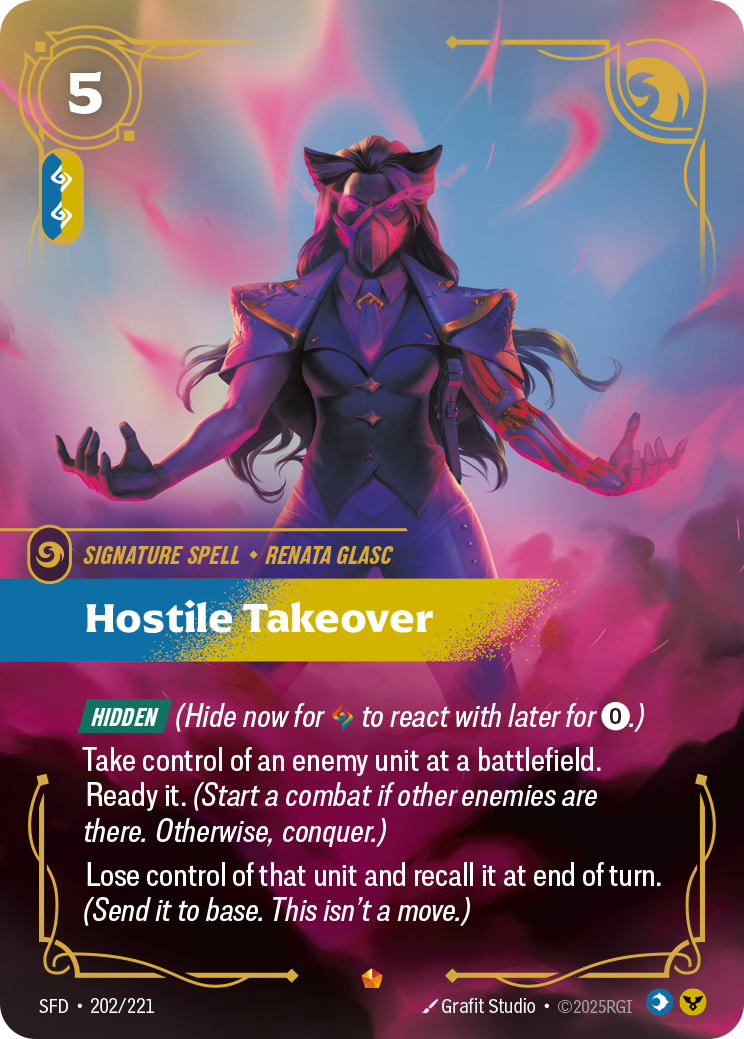
Q: If I use Hostile Takeover to take control of my opponent’s only unit at a battlefield, will there be a showdown? Will it be a combat?
You’ll start a noncombat showdown. (Hostile Takeover’s reminder text is a little misleading in this regard—you have to have some kind of showdown before you can conquer.) This ruling applies any time you have a unit at a battlefield when your opponent still controls that battlefield, but doesn’t have any units there. (Yes, that can happen. Hostile Takeover and Stormbringer are the easiest ways to do it.)
There’s a gap in the current rules that leaves this situation without an obvious outcome. We plan to address that gap in the next regular rules update. The issue is surprisingly complex, and we’re not 100% sure what the answer will be when we’re done.
In the meantime, though, we believe starting a noncombat showdown is the least disruptive way to handle this scenario. If you need really precise timing: assume that your opponent loses control of the battlefield in the same cleanup that begins the showdown, even though ordinarily control is “frozen” once the battlefield becomes contested.
Temporal Portal
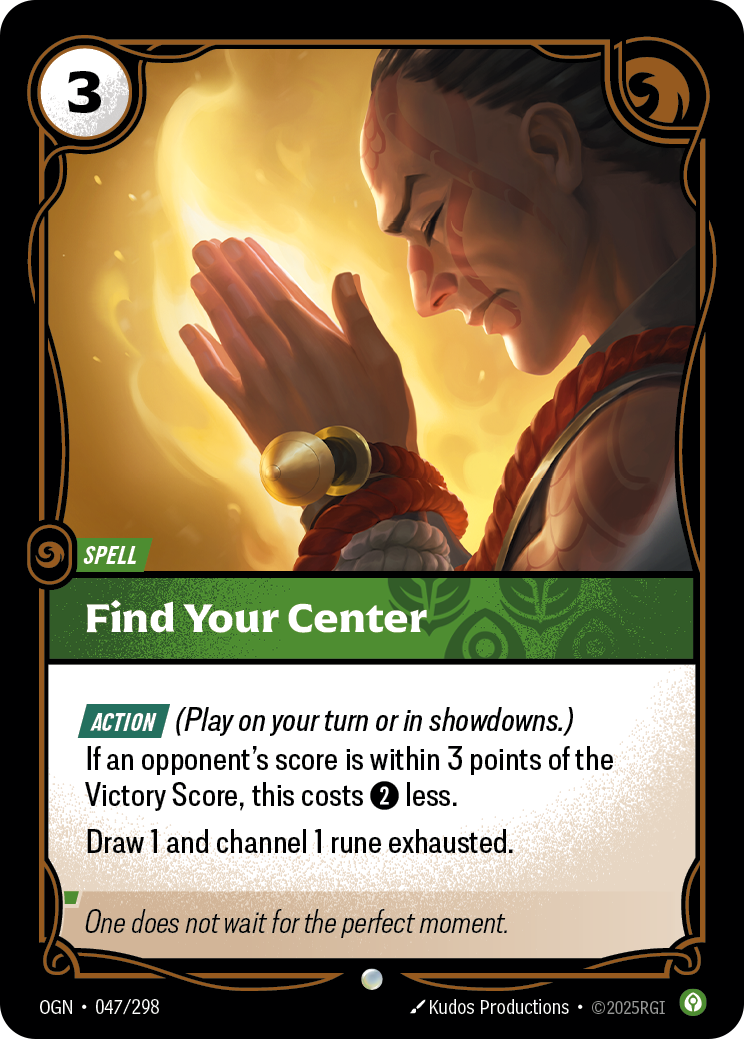
Q: What parts of a spell does the Repeat ability cause to be repeated? Is it the entire effect? If I use Temporal Portal to give Find Your Center Repeat and pay the cost while its cost reduction applies, does the cost reduction happen once or twice, and does the final spell cost 2 or 4?
Repeat causes you to repeat execution of a spell’s “instructions,” which are the things the spell tells you to do as it resolves. (We’ll give a better definition of “instructions” and how to define them in an upcoming rules update.) And the Repeat cost of Find Your Center isn’t reduced, even when its base cost is, because anything that asks for a card’s cost finds its printed cost as the answer.
This means that Find Your Center’s cost reduction applies only once and the final spell costs 4—its base cost of 3, plus its Repeat cost of 3, minus its cost reduction of 2.
Cards with Weaponmaster
Q: The reminder text of Weaponmaster says “You may”, but the Core Rules reads like it is mandatory. Which is it?
Oh, sharp catch. Weaponmaster as a keyword is always meant to be optional. While the rules utilize a language structure that imply a mandatory target, the reminder text is more accurate here. It is always a choice on whether or not to use this play ability. We will clean up that language in the future.