
Riftbound Core Rules: Spiritforged Patch Notes
Spiritforged Rules Patch Notes
Welcome to the Patch Notes for Riftbound, Spiritforged edition. Today we are going to be updating the Core Rules to support our newest expansion, Spiritforged! Included in today’s update are system clarifications, fixes to a few logical errors, and the new rules required to play with the mechanics included in the Spiritforged expansion.
What this is
In addition to the new Spiritforged cards, this is also an opportunity for us to speak directly with all of you about how these updates work, why we make them, and what they do. For instance, we have heard feedback from players about the “missing numbers” in the structure of the Core Rules. (The gap before rule 649 is the most noticeable, but fun fact, there are actually four of them!) These gaps are intentional. They help separate groups of rules and leave gaps for us which will minimize the need to renumber the rules going forward. These gaps don’t entirely eliminate the need to renumber, but they lessen it significantly.
The primary purpose of this rules update is to ensure that all the new cards in Spiritforged work when they’re released in China on December 12. To meet that goal, we’ve focused on the new systems required to support those cards. Some clarifications we could have made, or some housekeeping tasks we would have liked to tackle, have been left undone. We tried hard to get to things we felt we could address confidently while also getting you all the rules for Spiritforged.
This is what patch notes will typically look like: Systems updates, clarity, and new rules focused primarily on providing rules guidance about new cards and mechanics, and secondarily on fixing known issues in the rules. More importantly, it also illustrates what patch notes will never be: balance changes to your cards.
What this isn’t
Riftbound is a physical trading card game, and that means these updates serve only some of the purposes you might be accustomed to from “patch notes.” We change the rules to make new cards work and to work toward systemic stability for the game. We have also issued card errata (technical updates to the rules text of cards) for a number of cards in Origins. These errata are for the sake of clarity and error correction. We have no plans to use either rules updates or card errata to balance the power level of cards. Our updates are focused on system stability and growth for the future of Riftbound.
With these updates having the primary goal of supporting new releases, you can expect that rules updates like this will generally coincide with those releases. Because our releases are not (yet!) globally synched, however, these changes will have different impacts in different regions. In light of this, rather than taking effect immediately, these rules will have an effective date of December 12, 2025. This ensures that the Chinese release of Spiritforged is fully supported right away, while other regions have a little more time to absorb the rest of these changes without impacting major tournaments.
Without further ado, the changes themselves!
Patch Notes
- Spiritforged Addition: Attachment, Attached, and Detached
- Cards can now attach to other cards. The term “attach” is a verb, and is the act of one card being linked to another. Cards that attach will have a unique new frame that makes this really obvious. “Attached” is the state of being linked in such a way. “Detach” is the opposite verb, but there is no opposite state (everything isn’t constantly “detached,” it’s just not attached). We encourage players to overlay the card like you see below to represent how attached cards append their abilities to the card on top. (Seriously. Everything about attached cards will make more sense if you do it this way.)
-
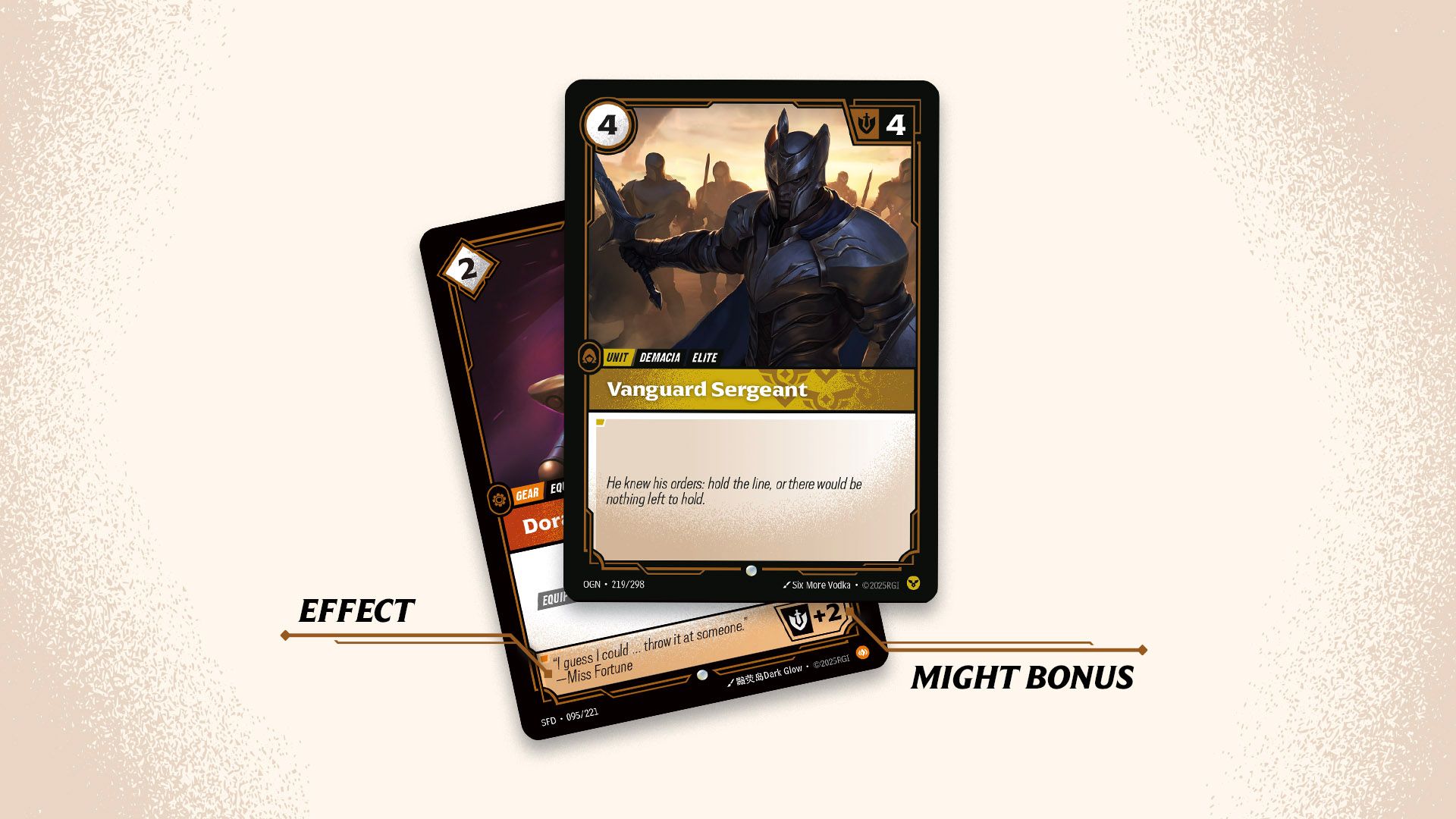
- Notably, the special frame for cards that attach also includes a Might Bonus. That number modulates the Might of the card on top.
- While a card is attached, its rules text becomes inactive, which we’ll get into in a
moment.
- NEW SYSTEM: Attachment, Attached, and Top-Most Card State added
- NEW SYSTEM: Effect Text added to Parts of a Card
- NEW SYSTEM: Might Bonus added to Parts of a Card
- NEW RULE: New rules added to layers to account for attachments and might bonuses
- NEW RULE: Attach action added
- NEW RULE: Detach action added
- Spiritforged Addition: Inactive text
- To support the state of cards being attached, the concept of text being inactive has been defined. Inactive text is text that is ignored. By default, certain sections of the new attachment frame—the effect text and might bonus—is inactive while the card is not attached. When a card with these text sections becomes attached, then that section stops being inactive, and its rules text becomes inactive instead.
-
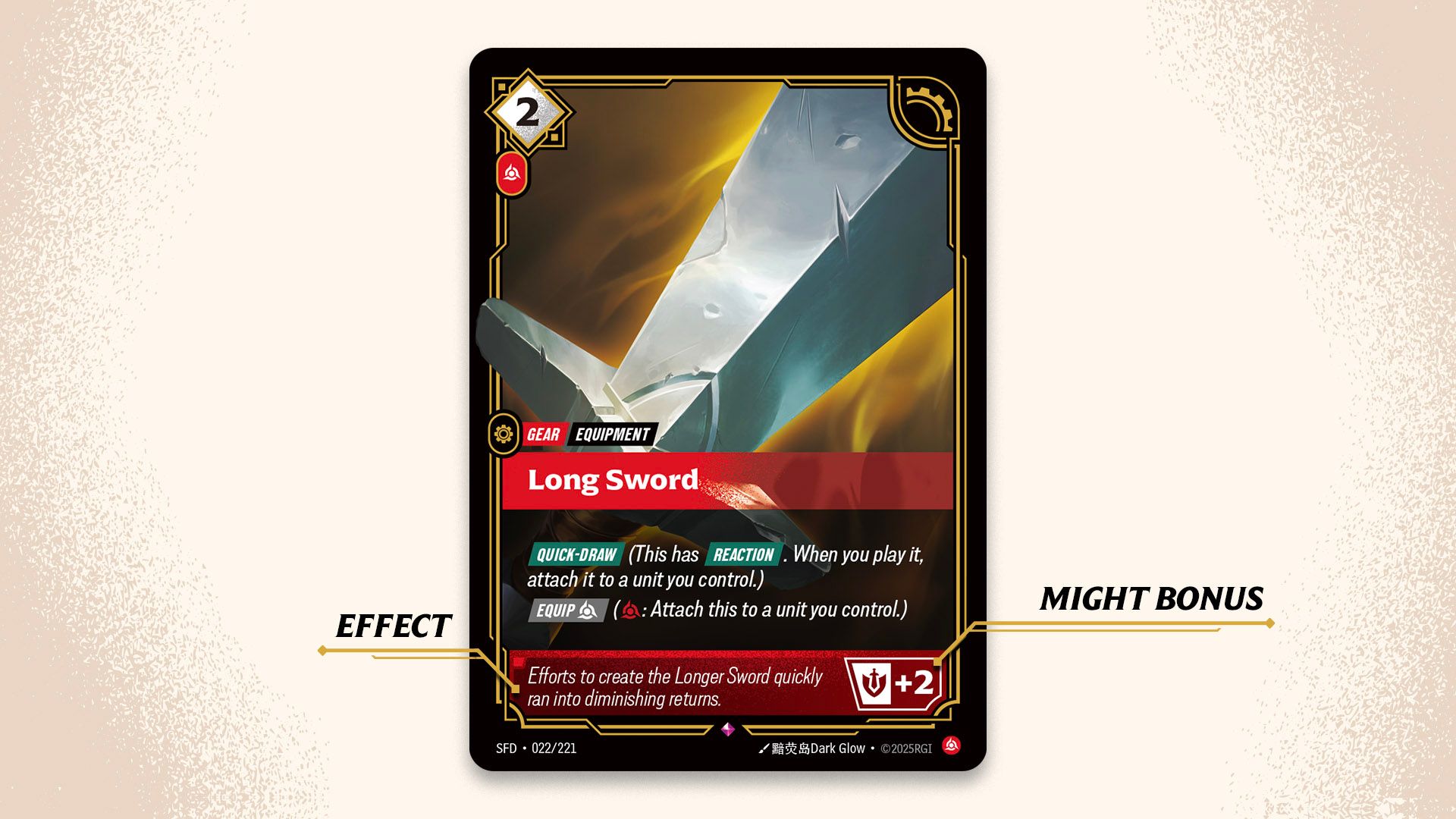
- While inactive text has no effect on the game, it does still exist. This means other effects can
still check on it. For example a card with Temporary still has Temporary even
if it is inactive and won’t trigger. So a hypothetical effect that said “Destroy a card with
Temporary” could still choose something with an inactive Temporary keyword. For the
full list of nuances and exceptions, check the Core Rules Document.
- NEW SYSTEM: Inactive Rules System Added
- Inactive but not forgotten
- NEW RULE: Exceptions toInactive rules added
- NEW SYSTEM: Inactive Rules System Added
- Spiritforged Addition: Equip
- The fancy part of the new expansion: the Equip keyword and the tag that goes with it, Equipment! Equip is fairly easy to explain now that we have the dense stuff about attaching cards out of the way. You simply pay the Equip cost listed next to the ability, choose a unit you control, and attach the Equipment to that unit.
- Notably, because of the way rules text becomes inactive when you attach these cards
to a unit, you can’t use an Equip ability if it’s already attached to something. On the bright
side, if the unit carrying it is killed or otherwise leaves the board, you keep the gear! Equip it to
the next contender and continue the fight.
- NEW RULE: Equip keyword added
- Get suited up
- NEW RULE: Equipment tag referenced in various rules
- NEW RULE: Equip keyword added
- Spiritforged Addition: Quick-Draw
- Some Equipment have a new keyword on them in addition to Equip. The new Quick-Draw
keyword lets you play (and consequently attach) Equipment straight from your hand at Reaction
speed. That is because Quick-Draw cards inherently have Reaction as a nested part of
Quick-Draw. In addition to granting Reaction, this keyword is also a Play Effect that attaches
the played Equipment directly to a unit you control—no need to pay the Equip cost. This time.
Quick-Draw doesn’t, however, change when you can use an Equipment’s Equip ability, only when
you can play it from your hand.
- NEW RULE: Quick-Draw keyword added
- NEW RULE: Quick-Draw contains Reaction
- Lickity-split
- Some Equipment have a new keyword on them in addition to Equip. The new Quick-Draw
keyword lets you play (and consequently attach) Equipment straight from your hand at Reaction
speed. That is because Quick-Draw cards inherently have Reaction as a nested part of
Quick-Draw. In addition to granting Reaction, this keyword is also a Play Effect that attaches
the played Equipment directly to a unit you control—no need to pay the Equip cost. This time.
Quick-Draw doesn’t, however, change when you can use an Equipment’s Equip ability, only when
you can play it from your hand.
- Spiritforged Addition: Weaponmaster
- Some units have a new keyword called Weaponmaster. This is a Play Effect that will choose an
Equipment you control, and then let you pay that Equipment’s E quip cost, reduced by
[A], to attach it to the Unit with Weaponmaster. The coolest part? It can even choose
Equipment that’s already attached to a different unit! Remember, inactive text like
Equip costs can still be referenced by other effects. Weaponmaster can check on that cost and
reference it to determine the cost you need to pay.
- NEW RULE: Weaponmaster keyword added
- NEW RULE: Exceptions and clarifications added to Inactive
- (This is a reminder—check out the Inactive section)
- Some units have a new keyword called Weaponmaster. This is a Play Effect that will choose an
Equipment you control, and then let you pay that Equipment’s E quip cost, reduced by
[A], to attach it to the Unit with Weaponmaster. The coolest part? It can even choose
Equipment that’s already attached to a different unit! Remember, inactive text like
Equip costs can still be referenced by other effects. Weaponmaster can check on that cost and
reference it to determine the cost you need to pay.
- Spiritforged Addition: Repeat
- Now here is something that bears repeating. Now here is something that bears repeating. A spell mechanic that
lets you get the effect of your spell a second time! Repeat is an optional additional cost that, when
paid, will let you execute the effect of the spell one additional time. You can only pay this cost once, and
this still only counts as playing the spell once (sorry, Ravenbloom Student).
- NEW RULE: Repeat as a keyword added
- It bears Repeating
- NEW RULE: Repeat as a keyword added
- Okay, we’ll stop
- NEW RULE: Repeat as a keyword added
- Now here is something that bears repeating. Now here is something that bears repeating. A spell mechanic that
lets you get the effect of your spell a second time! Repeat is an optional additional cost that, when
paid, will let you execute the effect of the spell one additional time. You can only pay this cost once, and
this still only counts as playing the spell once (sorry, Ravenbloom Student).
- Control of Abilities
- Added a rule to clarify the unlikely situation where control of an object changes while an ability originating
from that object is on the chain. Control of the ability will not change along with its originating
object.
- NEW RULE: Control of abilities on the chain is independent of the objects from which they originate
- Added a rule to clarify the unlikely situation where control of an object changes while an ability originating
from that object is on the chain. Control of the ability will not change along with its originating
object.
- Priority and Focus
- We wanted to take a moment and clarify the language in our rules around priority and focus. Priority is the
singular and exclusive right to take discretionary actions. Priority restricts actions for all players to one
bottleneck—only the player with priority may act. Focus, however, is like a “home base.” It is an additional
permission, and a tracking tool. Focus passes around to make sure everyone gets a turn to play Actions
in showdowns, even as priority bounces around from player to player. There is no situation where more than
one player can contest having authority to do something at the same time. So we took this opportunity to clear
some language up.
- CLARIFIED: Priority is the singular exclusive right to take discretionary actions during a closed state
- NEW RULE: Granting priority to a player either creates priority or removes it from a
player that has it
- No sharing. Even if you hold hands.
- NEW RULE: Having focus without priority does not grant the right to take discretionary actions
- We wanted to take a moment and clarify the language in our rules around priority and focus. Priority is the
singular and exclusive right to take discretionary actions. Priority restricts actions for all players to one
bottleneck—only the player with priority may act. Focus, however, is like a “home base.” It is an additional
permission, and a tracking tool. Focus passes around to make sure everyone gets a turn to play Actions
in showdowns, even as priority bounces around from player to player. There is no situation where more than
one player can contest having authority to do something at the same time. So we took this opportunity to clear
some language up.
- Deathknell
- Hey, we made Deathknell work. Okay, so Deathknell worked before, but it was fuzzy, and
annoying, and for many people not logically consistent. So we took a look at it and clarified some spaces, and
added additional steps in others explicitly to capture the intent of Deathknell. Now that Svellsongur
exists, and we want things that grant Deathknell to work without having to squint at it, this was our
call to do that work. Specifically there are new steps in Cleanups, Kill Instructions, and in the Deathknell
keyword itself to support this.
- CLARIFIED: Deathknell now works
- This, somehow, is a Kog’maw buff despite what we just wrote. Trust.
- NEW RULE: New rules added to Cleanups to support Deathknell
- NEW RULE: New rules added to Kill action to support Deathknell
- NEW RULE: New rules added to Deathknell to support remembering state and information about the game object with Deathknell after it dies
- CLARIFIED: Deathknell now works
- Hey, we made Deathknell work. Okay, so Deathknell worked before, but it was fuzzy, and
annoying, and for many people not logically consistent. So we took a look at it and clarified some spaces, and
added additional steps in others explicitly to capture the intent of Deathknell. Now that Svellsongur
exists, and we want things that grant Deathknell to work without having to squint at it, this was our
call to do that work. Specifically there are new steps in Cleanups, Kill Instructions, and in the Deathknell
keyword itself to support this.
- Cleanups
- We did some work to cleanups and special cleanups. We just discussed how we added new rules to support
Deathknell, but we also fixed a formatting and numbering error that made removing Contested
status appear to be a part of the end-of-combat special cleanup. It’s not! We have also added rules to clarify
when showdowns and combat are staged as well as when they cease to be staged.
- CLARIFIED: Removal of Contested status is not a part of the Special Cleanup at
the end of combat
- Call that a step in time
- NEW RULE: Added rule for ceasing showdowns being staged
- NEW RULE: Added rule for ceasing combat being staged
- CLARIFIED: Various improvements and adjustments across cleanups and special cleanups
- CLARIFIED: Removal of Contested status is not a part of the Special Cleanup at
the end of combat
- We did some work to cleanups and special cleanups. We just discussed how we added new rules to support
Deathknell, but we also fixed a formatting and numbering error that made removing Contested
status appear to be a part of the end-of-combat special cleanup. It’s not! We have also added rules to clarify
when showdowns and combat are staged as well as when they cease to be staged.
- Playing Units to Valid Locations
- As of the previous update, the rules specified that units could be played to any “valid location,” but
neglected to spell out which locations are valid. Oops. If you’ve read our learn-to-play materials you already
know the answer, but it turns out the rules didn’t actually define it. We’ve now fixed that, with both a default
and an allowance for exceptions.
- NEW RULE: By default, a player can play a unit to their base or to a battlefield they control
- NEW RULE: Specific cards may restrict or expand the list of valid locations
- Validating
- As of the previous update, the rules specified that units could be played to any “valid location,” but
neglected to spell out which locations are valid. Oops. If you’ve read our learn-to-play materials you already
know the answer, but it turns out the rules didn’t actually define it. We’ve now fixed that, with both a default
and an allowance for exceptions.
- Double and Swap
- Riftbound already had a card that “doubles” a unit’s Might. With the release of Spiritforged, we have
another one, plus a card that “swaps” two units’ Might. And while we could try to ride the simple
English meaning of those two words, it turns out there are some nuances we need to make explicit when those
verbs are being applied to numerical values for a limited duration. We’ve now added both double and
swap to our list of game actions. (Note that Gearhead gets away with using the simple English meaning
of double, because it’s not being used as a verb and doesn’t have a duration. Saying that a gear “gives double
its Might bonus” is the same as saying it “gives twice its Might bonus.”)
- NEW RULE: Double added to the list of game actions
- This bears—no wait
- NEW RULE: Swap added to the list of game actions
- NEW RULE: Double added to the list of game actions
- Riftbound already had a card that “doubles” a unit’s Might. With the release of Spiritforged, we have
another one, plus a card that “swaps” two units’ Might. And while we could try to ride the simple
English meaning of those two words, it turns out there are some nuances we need to make explicit when those
verbs are being applied to numerical values for a limited duration. We’ve now added both double and
swap to our list of game actions. (Note that Gearhead gets away with using the simple English meaning
of double, because it’s not being used as a verb and doesn’t have a duration. Saying that a gear “gives double
its Might bonus” is the same as saying it “gives twice its Might bonus.”)
- CLARIFIED: Various housekeeping and updates to language across the document, including adjusting or removing examples that are no longer accurate